
How to Get Court Records
Start with the court named on the docket, notice, or order. Christina J. Ovalle, the 38th Judicial District Clerk, keeps district civil, criminal, family, juvenile, and related papers. Donna M. Williams, the Uvalde County Clerk, keeps constitutional County Court misdemeanor, probate, and county-court records. Each justice court and the Uvalde and Sabinal municipal courts holds its own case file. That division controls where a request must go.
- Identify the court, case number, party name, and the exact paper or date range needed.
- Check the County Clerk's LGS index or re:SearchTX when the file may be available electronically.
- For a district file, call or visit the District Clerk. For a county file, call, visit, or mail the County Clerk. Contact the named JP or municipal clerk for lower-court files.
- Ask whether email can be used for the request. Uvalde Municipal Court expressly accepts written requests by hand delivery, mail, commercial delivery, fax, or email.
- Confirm search, copy, certification, and mailing charges before paying, then specify whether a plain or certified copy is required.
A phone call is useful for locating a file and confirming the right counter, but it does not itself produce an authenticated copy. The statewide re:SearchTX service is another route for eligible electronic documents, subject to account, court-integration, and security limits. Texas does not provide one complete statewide trial-court search, so a missing online result should be checked with the originating clerk.
Two Uvalde County Court Record Counters
The fastest way to avoid a rejected request is to separate the two courthouse custodians. The District Clerk is registrar, recorder, and custodian for papers filed in the 38th District Court. The County Clerk handles the constitutional County Court and probate files. Both offices are at the courthouse complex, but a request delivered to one does not become a request to the other.
| Custodian | Typical Uvalde County records | Contact |
|---|---|---|
| 38th Judicial District Clerk | Felony, district civil, family, juvenile, tax, and other district case files | (830) 278-3918 |
| Uvalde County Clerk | County Court misdemeanor, probate, and county-court case records | (830) 278-6614 |
| JP or municipal clerk | Justice-court civil and traffic files or city Class C and ordinance files | Contact the court printed on the case paper |
The District Clerk is at Courthouse Plaza, Box 15, Suite 15, Uvalde, Texas 78801. The County Clerk is at 100 N. Getty Street, first floor, with mail to P.O. Box 169, Uvalde, TX 78802. County Clerk hours published during the research were 8:00 a.m. to 4:30 p.m., including lunch. Confirm current access before travel.
Types of Court Records
A docket is the chronological index of activity. The court record is the larger case file behind it. Uvalde County court records may exist as recent electronic images, paper folders, scanned minute books, or index entries that lead staff to an older file. The available set depends on court level, case type, age, and access law.
- Docket sheets, indexes, and court minutes that trace activity.
- Petitions, complaints, answers, motions, briefs, and filed attachments.
- Signed orders, judgments, dispositions, and sentencing papers.
- Civil, criminal, family, probate, tax, and justice-court files held by the proper clerk.
- Certified copies bearing the custodian's certification or seal.
Transcripts are a separate product. The court reporter, not the clerk's ordinary copy counter, prepares a verbatim hearing or trial transcript. Likewise, the Civil Case Information Sheet is an initiation and classification form; it is not a request form and is not a substitute for the filed pleadings.
Uvalde County LGS Preview and Images
The County Clerk links to LGS Online Records Search. Official instructions describe guest access as well as registration. A guest can reach the index, run a search, move through result pages, preview available information, and purchase an image when the system offers one. Registration supports account functions, but an online image is still not automatically a certified court copy.
The official Q&A identifies a $0.30 transaction fee for an image purchase. It does not establish that every county-court paper is online or that every image has the same total cost. Search broadly enough to find the index entry, then ask the County Clerk about the complete file and certification. For district records, use the District Clerk or eligible re:SearchTX access instead of assuming LGS contains them.
The captured official LGS search interface shows the login and online records path used by the Uvalde County Clerk.
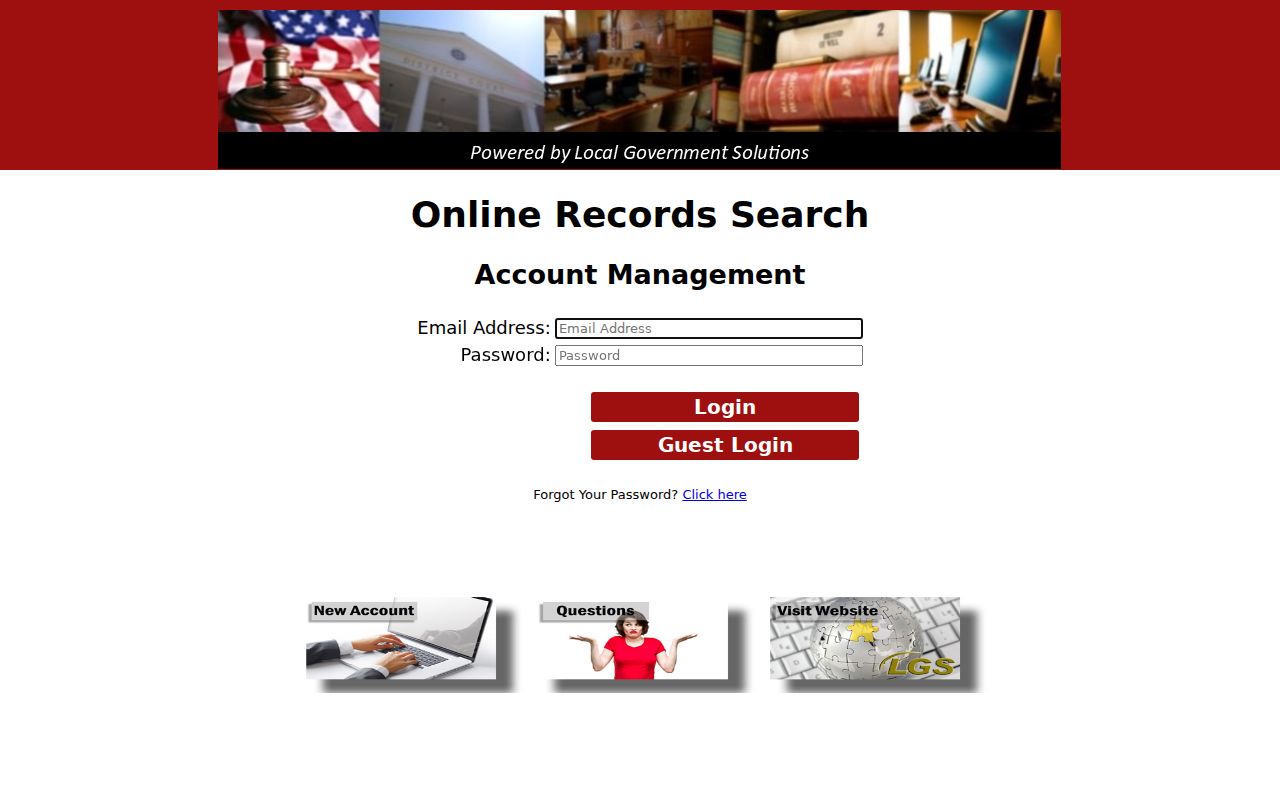
The screen is a starting point for an index or available image; the clerk remains the source for completeness and certified copies.
What a Court Record Contains
A Uvalde County court record joins identifying data with the papers filed over the life of a case. Not every field or document is public, and an index may describe an item without displaying its image. Read the docket date and description together, then request the paper itself when its text matters.
| Case identity | Case number, court, case type, filing date, and parties where public |
|---|---|
| Pleadings | Petitions, complaints, answers, motions, responses, and filed notices |
| Orders & judgments | Signed rulings, final judgments, disposition papers, or sentence information |
| Docket sheet | Dates and short descriptions of filings, settings, service, and court action |
| Attachments and exhibits | Materials accepted into the file, subject to sealing, redaction, and custody limits |
Uvalde County's 290-Book Record Archive
The District Clerk's preservation plan counts more than 290 books tied to civil and criminal actions. The holdings include court minutes, case folders, docket sheets, civil and criminal indexes, divorce minutes, tax judgments, civil fee sheets, grand-jury minutes, and several party indexes. It also identifies tax, CPS, Attorney General, and adoption folders, some of which are subject to strict access limits.
Old minute books were restored and digitally scanned, records are imaged by case file, and the office added a public station for viewing court records. The plan does not promise that every volume is searchable from home, nor does it state terminal export rules. For an older Uvalde County court record, give staff a party name, approximate year, court, and case type so the index and archive can be checked.
Archived or scanned does not mean unrestricted; the custodian still applies sealing, confidentiality, and redaction rules to each request.
Certified Copies and Fees
A plain copy reproduces a paper for reading. A certified copy adds the clerk's formal certification and may be needed when another court or agency requires proof from the official file. Order it from the custodian, not from a portal preview. Uvalde County's published district fee sheet lists the amounts below, but requesters should confirm the current total, page count, postage, and payment method.
| Item | Amount |
|---|---|
| Non-certified paper copy | $1 per page |
| Electronic copy | $1 per page |
| Certification or seal | $5 per document |
| Record search when no case number is supplied | $5 per name or item searched |
38th Judicial District Clerk
Courthouse Plaza, Box 15, Suite 15
Uvalde, TX 78801
(830) 278-3918
Details for a Uvalde County Record Request
A precise request saves search time and reduces the risk of receiving only an index. Give the court and case number when known, the names as they appear in the case, an approximate filing year, and the exact document or event sought. State whether the copy may be electronic, must be on paper, or must be certified. Ask for a cost estimate before a broad search.
For Uvalde Municipal Court, the local rules require public requests to be in writing and permit hand delivery, mail, commercial delivery, fax, or email to the Clerk of Court. Helpful details include the citation or case number, party role when relevant, requested document or event, date, and copy type. The municipal judge determines release. Those city rules should not be applied to the District Clerk or County Clerk, whose own procedures control their files.
Neither main county clerk publishes a guaranteed turnaround in the research. A large, old, or restricted request may take more work than a single known order. Call before sending payment or a time-sensitive request, and never send private identifiers that the office has not asked for.
Public Access and Sealed Records
Texas court records are generally available through the custodian unless a constitution, statute, rule, or court order limits release. Judicial case records are not governed in exactly the same way as county administrative records. A file may be absent online because it is sealed, confidential, redacted, too old for the portal, or simply not integrated. Juvenile records have special confidentiality rules, and sealed or in-camera documents do not become public merely because other entries in the case are visible.
Key access rules:
Texas Judicial Branch open-records policy explains that Rule 12 governs judicial administrative records while filed case records follow other law and court rules.
Texas Government Code Chapter 552 contains the Texas Public Information Act and its judiciary provision.
Texas Family Code Chapter 58 sets confidentiality rules for juvenile justice information and records.
When a Uvalde County Record Is Missing
An empty portal result is not a finding that no case exists. Check spelling, old names, filing year, and whether the search was made in the correct court system. LGS is the County Clerk route; re:SearchTX contains eligible electronic records subject to integration and security; a District Clerk archive or lower-court file may require direct contact.
If an entry appears but its image does not, ask the custodian for that named document. If staff say the material is sealed or confidential, ask what public docket information can still be released and whether a court order is needed. A requester seeking the procedural history rather than every paper may first use the Uvalde County case search to identify the court and case number, then return to the proper clerk for the actual file.