
How to Search Civil Dockets
The right clerk depends on the court. The 38th Judicial District Clerk keeps district civil and family records, while County Court and probate cases run through the Uvalde County Clerk. Small claims, evictions, and debt matters inside justice-court jurisdiction stay with the proper JP. Texas also offers the statewide re:SearchTX layer for eligible e-filed records, though what appears there depends on each court's integration and security settings.
Bring a cause number if you have one. Without it, a full party name, the filing year, the case type, and the likely court will narrow any name search considerably.
- Identify the court from the petition, citation, notice, or prior order.
- Use the correct local system or sign in to re:SearchTX.
- Search by cause number first, or use party names and verify the court and filing date.
- Read the chronology for service, answers, motions, orders, settings, and disposition.
- Request the judgment or a certified copy from the clerk that holds the original file.
Sometimes an online image is just a preview, or it carries a fee, or it simply never posts. In those situations, go straight to the local clerk for the real file.
Uvalde County Civil Docket Map
Uvalde County has no statutory county court at law on its books. Civil work splits three ways instead: the 38th District Court, the constitutional County Court, and the justice courts. Under the Texas County Clerk Manual, justice courts hold original civil jurisdiction up to $20,000. The district court's civil authority is broad. It also holds exclusive ground in areas like divorce and land-title disputes.
| Civil matter | Likely court | Record custodian |
|---|---|---|
| Broad civil, title to land, divorce, district family | 38th District Court | 38th Judicial District Clerk |
| Probate and matters within constitutional authority | Uvalde County Court | Uvalde County Clerk |
| Small claims, eviction, debt, and other claims within the limit | Applicable justice court | Clerk of that JP court |
| City ordinance matter | Municipal court only where authorized | Municipal clerk |
Sabinal Municipal Court does not hear civil cases at all. A Sabinal-area small claim or eviction belongs on the proper justice court docket, never the city's.
What a Civil Docket Shows
A Uvalde County civil docket opens with identity fields and then walks through events in date order. Expect to see the original petition, the citation and its return of service, an answer, discovery, motions, scheduling orders, hearing notices, judgment, enforcement, and any appeal. Treat each docket line as an index to activity. It rarely equals the full pleading or the signed judgment itself.
| Case number | The unique cause number assigned by the clerk; no public Uvalde format rule was confirmed. |
|---|---|
| Case style | Plaintiff and defendant, or petitioner and respondent, as formally captioned. |
| Case details | Filing date, court, judge, civil category, status, and amount range where shown. |
| Service and response | Citation issuance, return of service, answer, or other response. |
| Filings and settings | Motions, orders, docket-control events, hearing dates, and trial settings. |
| Outcome | Judgment, nonsuit, default, dismissal, enforcement, appeal, or mandate. |
These fields come from the local case-information sheet and the normal inventory a civil docket carries. No invented sample data appears here.
Uvalde County Civil Filing Sheet
The District Clerk links a Civil Case Information Sheet for any new family, probate, or mental-health case, plus certain post-judgment family actions. The form gathers the case style, filer contact details, party names and roles, case type, the requested procedure or remedy, and the damages range. Cause number and court assignment stay blank for the clerk to fill in.
Those categories double as a handy local index for docket reading: contract or debt, injury or damage, real property, family and post-judgment work, probate, tax, expunction, protective orders, civil rights, and other civil matters. The sheet helps the clerk classify a new filing. It proves nothing, though. It cannot replace the petition, and it never shows how a case ends.
Key distinction: A classification sheet describes the case at filing. The docket shows later events, and the signed judgment establishes the court’s ruling.
Types of Civil Cases on the Docket
The Uvalde County civil docket can carry many kinds of claims. Amount and subject decide which court level each one calls home.
- Contract, debt, and other commercial claims.
- Personal injury, damage, and other tort actions.
- Real-property disputes, including title matters assigned to district court.
- Divorce, family, protective-order, and post-judgment family proceedings.
- Probate matters kept through the County Clerk route.
- Justice-court small claims, evictions, and debt claims within jurisdiction.
Family, adoption, CPS, and juvenile-related material can face strict access limits. A public docket shell or non-sensitive event is one thing. Always ask the correct clerk before assuming you can view the rest.
Uvalde County Civil Docket Fees
The District Clerk's civil and family fee schedule took effect January 1, 2024, and covers filing and copy charges. Amounts can shift. Confirm the current fee before you file or mail payment. The official clerk page also links a statement of inability to afford court costs along with an appeal bond form.
| Published item | Amount |
|---|---|
| Base civil or family filing fee | $350 |
| Record search, each party | $5 |
| Certified copy | $1 per page plus $5 certificate and seal |
| Non-certified paper copy | $1 per page |
| Non-certified electronic document | $1 up to 10 pages, then $0.10 per added page |
| Listed enforcement, contempt, or similar ancillary motion | $80 total |
| Standard in-county sheriff service | $150 |
A portal screen is never a certified copy. Get the proper form and payment method from the District Clerk or County Clerk, tied to the actual court record.
Settings and Hearings on Civil Dockets
The Uvalde County civil chronology can hold a notice of setting, a docket-control order, a pretrial entry, a motion hearing, mediation, or a trial date. Old dates linger as history after a reset. So read events by date and hunt for the newest signed order or confirmed setting. The first date you spot is rarely the current one.
The 38th District Court posts its local rules, forms, and standing orders through the Texas local-rules portal.
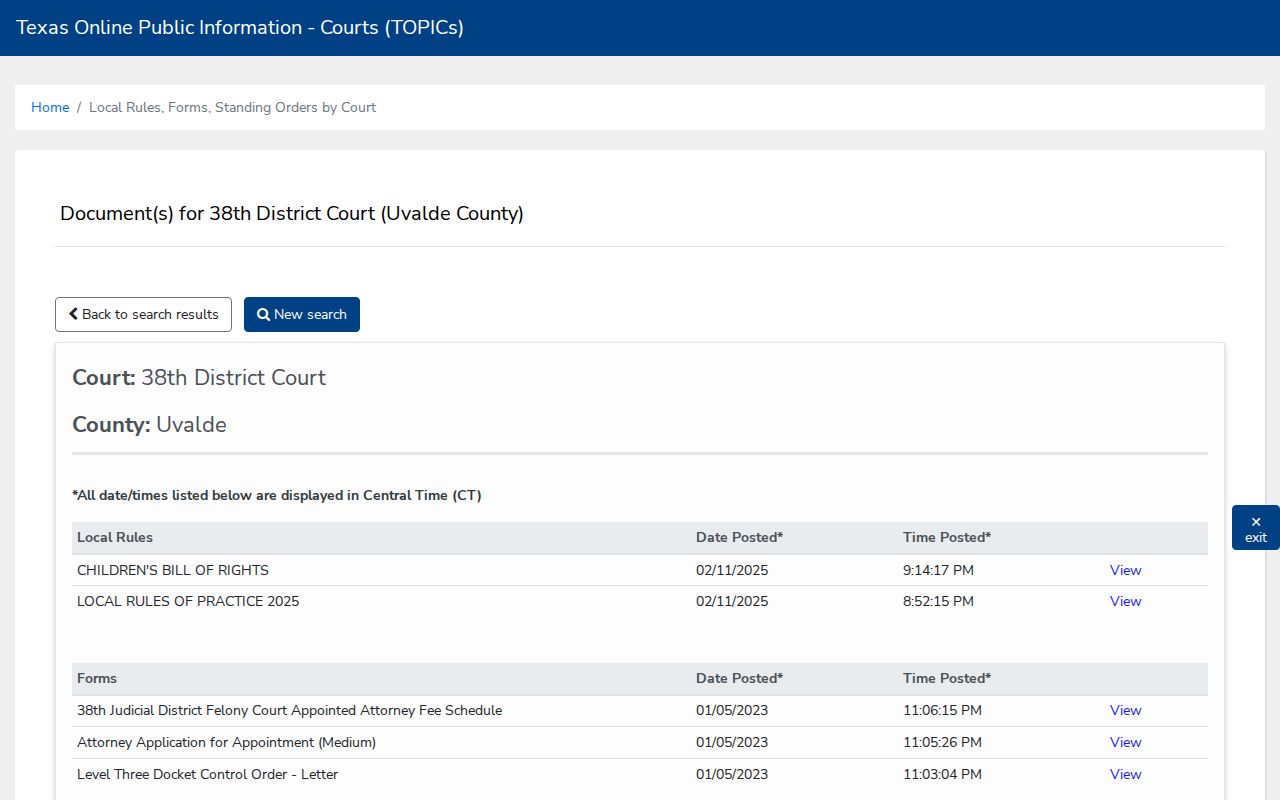
That portal confirms court-wide scheduling documents. A live case setting still needs a check with the docket and the coordinator. The full Uvalde County court calendar process covers resets and date checks in depth.
Uvalde County Civil Docket Outcomes
Civil dockets close out in several ways. You might see an agreed judgment, a default judgment, a judgment after trial, summary judgment, a nonsuit, or dismissal for want of prosecution. A nonsuit is the plaintiff's own dismissal under the governing rules. Default judgment can follow when a party fails to respond or appear. Dismissal for want of prosecution means the case stalled and got dropped. DWOP is the common shorthand for it. It is not confirmed as a local portal code.
Entries can multiply after judgment. The docket may add an abstract, a writ, garnishment, a turnover request, an enforcement motion, a modification, or an appeal. The Uvalde fee schedule lists an eight-dollar issuance charge for an abstract, garnishment, or citation. Entries like these do not spell out the full legal effect. When possible, read the filed request and the signed order behind them.
- Judgment
- The court’s final adjudicative decision.
- Nonsuit
- A plaintiff’s dismissal without a decision on the merits, subject to the rules.
- Default judgment
- A judgment tied to a failure to respond or appear as required.
- Mandate
- The appellate court’s formal direction returning the result to the lower court.
Public Access to Civil Dockets
How much you can see depends on the case. It also depends on the court and any order that limits disclosure, even within a Uvalde County civil docket. The LGS index and re:SearchTX both surface eligible case data. Images are another matter. They may be preview-only, paid, secured, or missing entirely. When screens fall short, the District Clerk and County Clerk counters still answer in person. A certified judgment comes only from the clerk where the case originated. Request it there.
Key access rules:
Texas Rule of Judicial Administration 12 governs access to covered judicial records and states its exceptions.
Texas Rule of Civil Procedure 76a supplies the sealing process for court records where it applies.
Texas Government Code Chapter 552 recognizes that judiciary records follow Supreme Court rules or other applicable law.
Texas Family Code Chapter 58 protects juvenile records.
A Uvalde County docket search can come up empty for several reasons. You may have asked the wrong clerk, hit an old index, found incomplete integration, opened a sealed file, or searched a different spelling of a name. If access is denied, ask the holding clerk which rule or order controls.
Uvalde County Civil Clerk Routes
The County Clerk's page connects filers to the LGS Online Records Search. It also spells out its filing rules. Civil and probate e-filing is mandatory. Self-represented filers keep paper and mail routes. One probate quirk stands out. An original will must reach the clerk within three business days after an e-filed probate application. So the custodian and case type matter before a filer picks a portal. The official Uvalde County Clerk page posts its online search, office hours, and filing links.
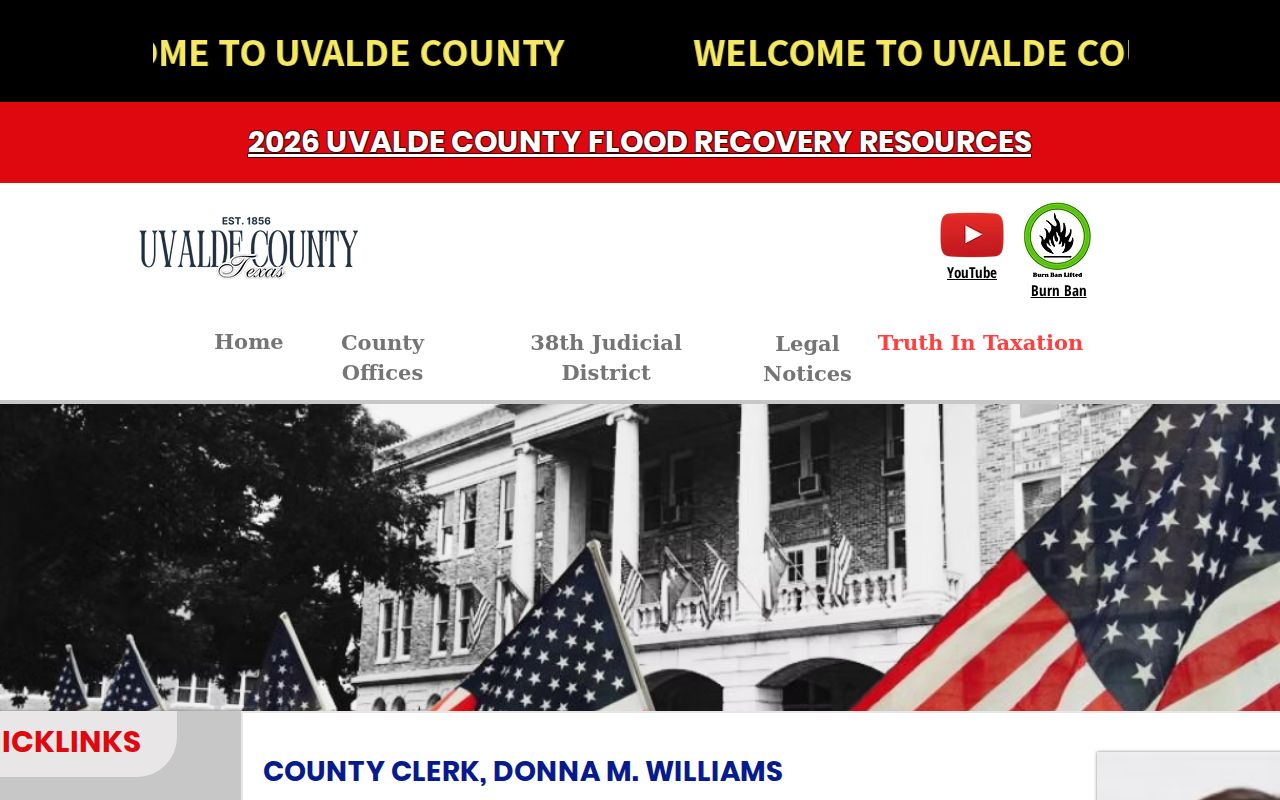
That official page sorts out the county and probate route. It sits apart from the District Clerk's district civil and family records. For District Court records, contact the District Clerk. The office sits at 100 North Getty Street, Suite 15, Uvalde, TX 78801, or call (830) 278-3918. County Court or probate records belong to the County Clerk. Reach that office at Courthouse Plaza, Box 11, Uvalde, TX 78801, or (830) 278-6614. A justice case is different. It goes through the precinct office that accepted the claim.